TL;DR
B2B manufacturing companies that invest in integrated digital marketing — covering brand positioning, content, social media, SEO/AEO, PR, and performance marketing — consistently report 30–60% lower client acquisition costs over a 2–3 year horizon, stronger sales team conversion rates, higher client retention, and compounding referral business. This article explains exactly how each marketing lever contributes to your bottom line, with data, frameworks, and actionable steps.
Every quarter, finance teams across B2B manufacturing companies run the same exercise: looking for costs to trim. Sales team headcount, travel budgets, trade show expenses — these are the usual suspects. What rarely shows up in this conversation is a deeper, more structural question: Why does acquiring each new client cost so much in the first place?
The answer, more often than not, comes down to brand. When nobody has heard of you, every conversation starts from zero. Your sales team spends the first part of every meeting establishing credibility. Conversion timelines stretch. Follow-up cycles multiply. Proposals get compared against competitors who are better known, not necessarily better suited.
The businesses that crack this problem — and they exist across every manufacturing sub-sector — are the ones that treated digital marketing not as a cost centre, but as a structural investment in reducing their cost of sale. This article draws on patterns observed across B2B manufacturing clients to map out exactly how that works, where the ROI comes from, and what an integrated strategy looks like in practice.
5–7× more expensive to acquire a new client than to retain an existing one | 57% of B2B purchase journeys happen before the first sales conversation | 3× higher conversion rates for warm, brand-aware inbound leads vs cold outreach |

Section 1: The Real Cost of Sales in B2B Manufacturing
In most B2B manufacturing companies, the sales function absorbs between 15% and 30% of revenue when you factor in salaries, commissions, incentives, travel, trade events, and the tools required to run an outreach function. For SMEs with turnover between ₹20 crore and ₹500 crore, this is typically the single largest discretionary cost bucket.
CFOs and business owners naturally look at the headcount within this function when pressure mounts. But headcount cuts rarely solve the underlying problem — they just create capacity issues. The smarter lever is improving the productivity of every sales rupee spent, and digital marketing is the most powerful way to do that.
Where Sales Costs Accumulate — A Typical B2B Manufacturing Company
| Cost Category | Typical % of Revenue | Root Cause | Digital Marketing Impact |
| Sales team salaries & incentives | 8–15% | Long cycles, low conversion | Shorter cycles via brand-warmed prospects |
| Travel & client entertainment | 2–5% | Cold outreach; multiple meetings to close | Fewer cold meetings; digital pre-qualification |
| Trade shows & exhibitions | 2–4% | High cost per qualified lead | Digital channels generate warm leads cheaper |
| Proposal & pitch resources | 1–2% | Low win rates on cold proposals | Higher win rates on inbound, brand-aligned RFQs |
| CRM & sales tools | 0.5–1.5% | Data overhead, duplicate outreach | Integrated marketing reduces duplicate touchpoints |
| Client attrition & re-acquisition | 3–6% | Weak post-sale engagement | Content & community retain clients longer |
The table above reveals an important truth: most sales costs are symptoms of a brand recognition deficit. Digital marketing addresses the root cause, not just the symptom.
Section 2: Brand Resonance — The Silent Sales Accelerator
Let’s talk about something that doesn’t usually appear on a P&L but drives almost everything that does: the moment a potential client hears your company name and already knows who you are.
This is brand resonance — not just awareness, but positive, trust-laden familiarity within your target community. In B2B manufacturing, where purchase decisions are high-stakes, long-cycle, and often made by committees, this kind of pre-established trust is worth more than any individual sales tactic.
What Brand Resonance Actually Looks Like in Practice
- A procurement manager at a potential client sees your LinkedIn post on sustainable packaging innovations before your sales team calls.
- A plant head has read three of your case studies about downtime reduction before the demo. The meeting starts with alignment, not introduction.
- A CFO at a prospect firm is already following your thought leadership because a peer in the industry recommended it.
In each of these scenarios, the sales conversation is starting from a position of earned trust rather than a cold ask. The measurable impact is immediate and compounding.
The Brand Resonance → Revenue Connection
| Stage | Without Brand Resonance | With Brand Resonance | ROI Impact |
| First meeting | 30–40% acceptance rate on cold outreach | 60–75% acceptance rate for brand-recognised outreach | 2× meetings per sales headcount |
| Conversion rate | Typically 8–12% on cold pipeline | 20–35% on warm/inbound pipeline | 3× revenue per deal cycle |
| Deal cycle length | 6–18 months typical in manufacturing | 3–9 months for brand-aware prospects | Faster revenue realisation |
| Proposal win rate | 15–25% on cold RFQs | 35–55% where brand trust exists | Higher return on bid effort |
| Client onboarding NPS | Benchmark satisfaction | Higher — expectations matched by reputation | Retention advantage from day 1 |
| Key Insight | Brand resonance is not a marketing vanity metric. It is a direct multiplier on your sales team’s output — more meetings accepted, faster cycles, better win rates. Every rupee spent building brand in your target sector reduces the effective cost per client acquired. |
Section 3: The Integrated Digital Marketing Model for B2B Manufacturing
Digital marketing for B2B manufacturing is not about running Facebook ads or posting product photos on Instagram. It is about orchestrating multiple disciplines — each reinforcing the other — to create a brand ecosystem that works for your sales function 24 hours a day.
Below is a comprehensive map of the core service areas, what each does for a manufacturing company, and the specific commercial impact it drives.
Integrated Digital Marketing Services — B2B Manufacturing Impact Map
| Service Area | What It Does in B2B Manufacturing | Direct Commercial Benefit | Timeline to Impact | Cost Optimisation Effect |
| Brand Strategy & Positioning | Defines a sharp, differentiated narrative — why you exist, who you serve best, and why clients should trust you over alternatives. | Shorter sales cycles; higher meeting-to-close ratios | 3–6 months | Reduces cost-per-meeting and bid preparation waste |
| Content Marketing | Technical articles, case studies, white papers, application notes that demonstrate deep domain expertise to engineers, procurement heads, and C-suite. | Builds credibility before the sales call; enables inbound leads | 4–8 months | Reduces dependency on expensive outbound campaigns |
| LinkedIn & B2B Social Media | Thought leadership, company updates, employee amplification, and targeted visibility in niche manufacturing and procurement communities. | Executive visibility drives relationship capital; community builds trust | 2–5 months | Replaces some trade show spend; cheaper per qualified connection |
| Search Engine Optimisation (SEO) | Ranking for terms that procurement teams, engineers, and operations managers actually search when they have a problem your company solves. | High-intent inbound traffic; leads that come to you | 6–12 months | Lowest long-term cost per qualified lead of any channel |
| Answer Engine Optimisation (AEO) | Structuring content to be cited by AI tools (ChatGPT, Perplexity, Gemini, Claude) when buyers ask questions your category answers. | Discovery in AI-powered research journeys — the new first touchpoint | 4–8 months | Future-proofs discoverability as AI search grows |
| Performance Marketing (PPC/Display) | Targeted, intent-driven paid campaigns on Google, LinkedIn, and industry platforms — reaching decision-makers at the right moment. | Immediate pipeline generation with measurable ROAS | 1–3 months | Reduces cost per qualified lead by up to 40% vs trade shows |
| Strategic PR & Media Relations | Placements in trade publications, industry analyst reports, sector-specific media that your TG reads and trusts. | Third-party credibility amplification; trust transfer from publication to brand | 3–6 months | Reduces objection-handling time in sales; accelerates close |
| Email Marketing & Nurture | Segmented, personalised communication to leads and existing clients — delivering value at every stage of the funnel. | Maintains warm pipeline; drives re-engagement and cross-sell | 2–4 months | Dramatically reduces client attrition; improves LTV |
| Video & Visual Content | Plant walkthrough videos, product explainers, client testimonials, process animations — making the intangible tangible. | Builds confidence at evaluation stage; reduces in-person visit requirements | 3–5 months | Reduces expensive in-person demo travel costs |
| CRM & Marketing Automation | Connecting digital marketing activity to sales pipeline — tracking, scoring, and nurturing leads systematically. | Sales team efficiency; no lead falls through the cracks | 2–4 months after setup | Reduces sales overhead; improves conversion of existing pipeline |
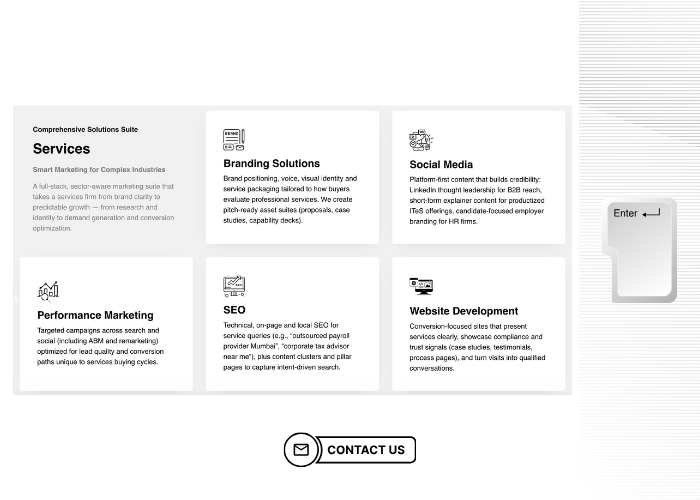
Notice how these services stack. Content marketing feeds SEO. SEO drives inbound leads. PR amplifies brand. Social media distributes content. Automation nurtures leads. Each layer multiplies the output of the others — this is what ‘integrated’ actually means.
Section 4: How Digital Marketing Directly Reduces Client Acquisition Costs
The Acquisition Cost Reduction Flywheel
Client acquisition cost (CAC) is one of the cleanest metrics for evaluating marketing efficiency. In B2B manufacturing especially contract maufacturing, where a typical deal has significant lifetime value, even a 20–30% reduction in CAC has an outsized bottom-line impact.
Here is how the flywheel operates across the client journey:
| Flywheel Stage | The Mechanism | Marketing Lever | CAC Reduction Driver |
| Awareness | TG encounters brand via content, SEO, social, or PR before any commercial intent exists. Familiarity is formed. | Content + SEO + LinkedIn + PR | Reduces outbound reach costs; more prospects already know you |
| Consideration | When a need arises, your brand surfaces — on Google, in peer recommendations, through AI tools. You are in the consideration set. | SEO + AEO + Review management | Eliminates cold-start conversations; higher meeting acceptance rates |
| Evaluation | Decision-makers research you. Case studies, technical content, and video evidence do the job your sales team would otherwise need to do. | Content marketing + Video + Website | Compresses evaluation stage; reduces proposal iteration costs |
| Conversion | Sales conversation happens with informed, pre-warmed prospects. Credibility is pre-established. Deal cycle shortens. | All channels converging | 2–3× improvement in conversion rate = CAC cut in half or better |
| Onboarding | Positive first experience amplified via digital touchpoints — welcome content, personalised communication, community access. | Email nurture + Social | Reduces early churn; protects acquisition investment |
| Retention & Advocacy | Satisfied clients share experience. Content keeps the relationship warm. Referrals arrive organically. | Ongoing content + PR + Community | Referral leads have near-zero acquisition cost — the ultimate CAC reduction |
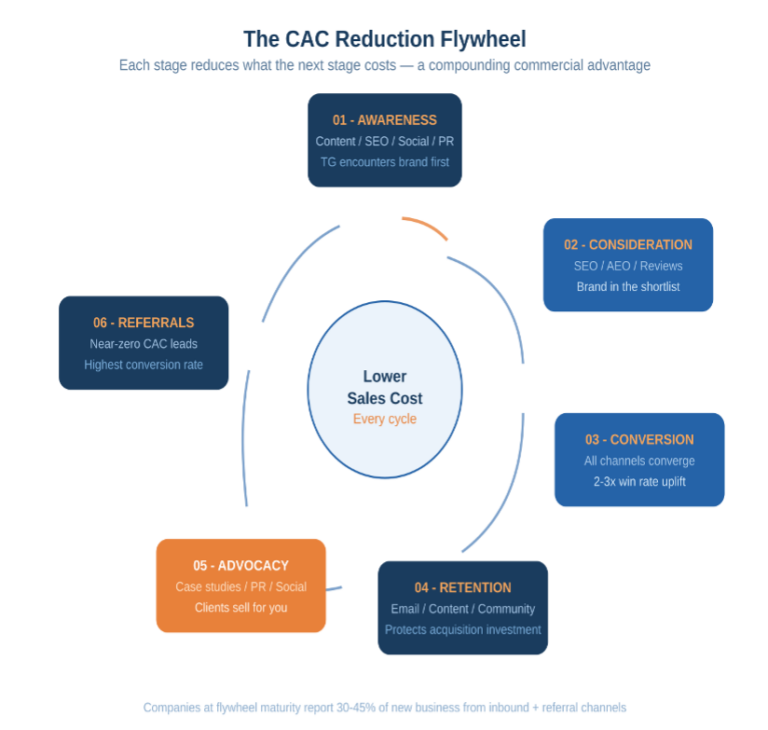
| The Compounding Effect | A company that invests consistently in digital marketing for 24–36 months typically finds that 30–45% of new business is arriving through inbound or referral channels — both with dramatically lower acquisition costs than outbound. The sales team’s time shifts from prospecting to closing. Productivity per head rises. Revenue per sales rupee improves. |
Section 5: Retention, Advocacy, and the Commercial Multiplier
The Client You Keep Is Worth 5× the Client You Acquire
B2B manufacturing companies including contract manufacturers, often have naturally sticky clients — long supply chain relationships, high switching costs, custom tooling and processes built around each other. But ‘naturally sticky’ is not a retention strategy. It just means the cost of losing a client is usually catastrophic, since they rarely leave for a minor reason.
Retention-Driving Digital Activities — What Works in Manufacturing B2B
| Activity | Format | Retention Mechanism | Commercial Outcome |
| Industry newsletter with insights | Monthly email to client base | Positions you as a knowledge partner, not just a vendor | Higher wallet share; lower churn risk |
| Case study featuring client success | PDF + LinkedIn post + website | Client feels valued; peers see social proof | Deepens relationship; triggers referral conversations |
| Sector trend reports | Annual or bi-annual white paper | Demonstrates you understand their industry evolution | Reinforces premium positioning; harder to replace |
| Behind-the-scenes plant content | Video + social media | Builds trust in your operations and quality culture | Reduces audit anxiety; accelerates re-order decisions |
| Client appreciation touchpoints | Social recognition + personalised emails | Human connection in a B2B context | Emotional loyalty beyond transactional relationship |
| Technical webinars & knowledge sessions | Live or recorded | Continuous education establishes authority and dependence | Clients use you as a strategic advisor, not a commodity vendor |
Advocacy: When Your Clients Sell for You
The most cost-efficient business development engine a B2B manufacturer can build is a structured advocacy loop. It works like this: excellent work + amplified client experience + strategic digital visibility = clients who recommend you without being asked.
Referral leads have the lowest cost of acquisition of any channel. They arrive pre-validated, pre-trusting, and typically convert at 3–4× the rate of cold outbound. In sectors where trust is paramount — precision manufacturing, industrial components, specialty materials — a referred introduction is worth more than any paid campaign.
| Advocacy Driver | How Digital Marketing Amplifies It | Business Impact |
| Client success stories | Co-authored case studies, joint LinkedIn features, PR placements | Brand credibility + referral signals to peer networks |
| Industry awards & recognition | PR strategy to maximise award visibility | Third-party validation; increases referral confidence |
| Community participation | Facilitating industry forums, WhatsApp groups, webinar panels | Network centrality — being the brand at the centre of the ecosystem |
| Executive personal brand | Thought leadership on LinkedIn for founders & senior leaders | Personal trust transfers to company trust; drives direct referrals |
| Post-project digital amplification | Project completion posts, testimonial videos, performance announcements | Signals active portfolio to new prospects browsing your history |
Section 6: Sales Team Productivity — The Often Overlooked Multiplier
Here is an under-discussed truth about B2B manufacturing sales: your salespeople are not inefficient — they are under supported. When brand and digital marketing are absent, your sales team is doing the job of a marketer, a content creator, a credibility builder, and a closer — simultaneously. That is an expensive use of talent.
How Digital Marketing Liberates Sales Productivity
| Without Digital Marketing | With Integrated Digital Marketing | Productivity Shift |
| Sales team introduces company at every meeting | Prospect already knows company from content/PR | First 20 minutes of meeting freed up |
| Long email threads establishing credibility | Digital collateral pre-validates expertise | Proposal conversion rates improve 30–50% |
| Repeat demos for same features | Video explainers do first-level demos | Demo time reduced; high-value meetings only |
| Cold calling to generate pipeline | Inbound leads from SEO + content supplement outreach | More pipeline; same headcount |
| Education from scratch with each lead | Leads already familiar with your value proposition | Shorter cycle; higher win rate |
| High volume of low-quality meetings | Digital pre-qualification filters intent | Fewer but higher-quality meetings; better close ratio |
| Think of digital marketing as a force multiplier. A sales team of 10 supported by an integrated digital strategy performs like a team of 16–18 in terms of pipeline coverage and conversion efficiency — without adding a single headcount. |
Section 7: The Investment vs. Return Reality Check
Yes, Digital Marketing Costs Money. Here Is Why It Saves You More.
Any honest advisor would tell you this directly: digital marketing is not free. A well-structured programme for a mid-sized B2B manufacturing company is a reasonable cost depending on scope. That is a material investment that needs to be justified.
The argument for this investment is not about vanity metrics — it is purely about the economics of client acquisition and retention over time.
| Time Horizon | Expected Marketing Output | Commercial Impact | Sales Cost Trajectory |
| Months 1–3 (Foundation) | Brand audit, content infrastructure, SEO baseline, social presence activation, PR pipeline initiated | Minimal direct pipeline impact; brand positioning established | Investment phase — costs may feel front-loaded |
| Months 4–8 (Momentum) | First content traction, improved search rankings, LinkedIn community growth, PR placements landing | Early inbound inquiries; warm lead quality improves; sales meetings easier to book | CAC begins to show measurable improvement; conversion rates tick up |
| Months 9–18 (Compounding) | SEO rankings solidify, thought leadership established, referral velocity increasing, AEO citations appearing | Steady inbound stream supplements outbound; client retention metrics improve | Total sales cost as % of revenue down 20–35% vs year 1 |
| Months 18–36 (Flywheel) | Brand is a recognised authority in niche; advocacy engine running; competitors notice the market position | Referral + inbound covers 30–45% of new business; CAC down significantly | Sales team productivity peaks; headcount efficiency maximised |
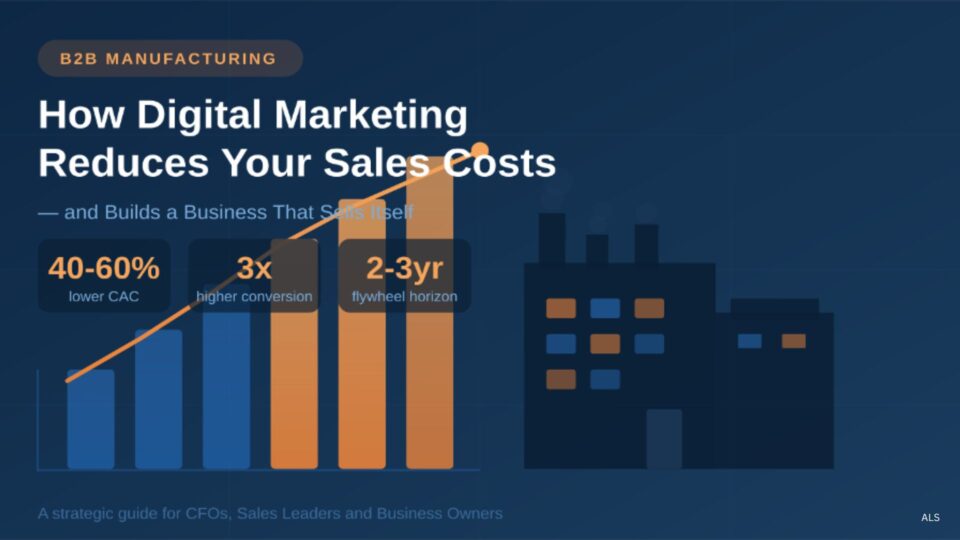
The key insight is this: the cost of digital marketing is largely fixed in the short term but its output is compounding in the long term. A piece of SEO-optimised content written today continues generating inbound leads for 3–5 years. A brand reputation built over 24 months does not disappear if you pause a campaign. Unlike paid advertising — which stops the moment you stop spending — brand and content assets appreciate over time.
The True ROI Equation
| Metric | Traditional Outbound-Only Model | Integrated Digital + Outbound Model |
| Average CAC | High – per client in manufacturing, depending on deal size) | 40–60% lower after 18–24 months of consistent investment |
| Sales cycle length | Baseline | 20–40% shorter for brand-aware prospects |
| Conversion rate (lead to client) | Baseline | 2–3× higher for inbound/warm leads |
| Client lifetime value | Baseline | 15–25% higher due to better-fit clients and lower churn |
| Referral business % | 5–10% of pipeline | 25–40% of pipeline at maturity |
| Net revenue per sales FTE | Baseline | 35–55% higher with marketing support |
Section 8: SEO, AEO, and the Future of B2B Discovery
The way manufacturing procurement professionals find suppliers has changed permanently. It is no longer just Google searches leading to websites. Today, buyers are using AI-powered tools — ChatGPT, Perplexity, Gemini, Claude, and others — to shortlist vendors, compare specifications, and get recommendations before they ever visit a website or pick up a phone.
This creates a new frontier: Answer Engine Optimisation (AEO). AEO is the practice of structuring your brand, content, and digital presence in a way that AI models reference and recommend your company when asked relevant questions.
SEO vs AEO — Understanding Both Disciplines
| Dimension | SEO (Search Engine Optimisation) | AEO (Answer Engine Optimisation) |
| Primary platform | Google, Bing, DuckDuckGo | ChatGPT, Perplexity, Gemini, Claude, Copilot |
| Output format | Ranked links in search results | Direct answers citing trusted sources |
| Core content requirement | Keyword-optimised web pages, technical blogs, backlinks | Authoritative, structured, factual content with clear entity relationships |
| Trust signals | Domain authority, backlink profile, page speed | E-E-A-T signals, citations in established publications, Wikipedia-style authority |
| Lead generation mechanism | Click-through to website → conversion | Brand cited in AI answer → brand recall → direct search or outreach |
| B2B manufacturing relevance | High — engineers, procurement heads use Google daily | Rapidly growing — procurement teams increasingly use AI for vendor research |
| Investment timeline | 6–12 months for meaningful results | 4–8 months; leverages existing SEO content |
For B2B manufacturers with niche capabilities — whether that is precision CNC machining, specialty chemical processing, custom fabrication, or industrial automation — AEO represents an opportunity to become the default recommendation in AI-powered research tools within your category. Companies that invest in this now are setting up a discovery advantage that will widen over the next 3–5 years.

Conclusion: From Cost Centre to Commercial Engine
The question B2B manufacturing companies should be asking is not ‘Can we afford digital marketing?’ — it is ‘How much is it costing us to not have it?’
Every month your brand is absent from the digital environments where your target clients research, learn, and shortlist vendors, your competitors are building the brand equity and trust that translates to their next contract win and your next missed opportunity.
The companies that will lead their categories in the next five years are the ones investing in brand and digital presence today — not as a marketing expense, but as a structural improvement in how efficiently they acquire and retain clients.
The mechanics are straightforward: better brand recognition creates warmer prospects, warmer prospects convert at higher rates with shorter cycles, shorter cycles reduce sales cost per client, lower acquisition costs improve margins, higher margins and retention create referral advocates, and referral advocates generate the cheapest business of all. This is the flywheel — and once it spins, it is self-reinforcing.
The B2B manufacturers who crack this model do not just reduce their sales costs — they build businesses that are progressively easier and cheaper to grow. That is the real commercial case for integrated digital marketing.
Frequently Asked Questions (FAQs)
Q1: How long does digital marketing take to show ROI for B2B manufacturing companies?
Most B2B manufacturing companies begin to see measurable CAC improvements within 9–18 months of consistent investment. Quick wins — improved meeting acceptance rates, better-quality inbound leads — typically appear within 4–6 months. SEO and brand authority take 12–24 months to fully compound. The key variable is consistency: intermittent effort delays the flywheel significantly.
Q2: What is the difference between B2B and B2C digital marketing for manufacturers?
B2B manufacturing digital marketing is focused on decision-making committees (not individual consumers), longer sales cycles (months to years), high-ticket, relationship-driven contracts, and highly technical content requirements. The channels prioritised differ — LinkedIn, trade PR, and SEO for professional queries matter more than Instagram or consumer Facebook. Metrics are pipeline-oriented (CAC, conversion rate, deal velocity) rather than volume-oriented.
Q3: How much should a B2B manufacturing SME spend on digital marketing?
A reasonable starting benchmark is 5–10% of target new business revenue. For an SME targeting ₹50 crore in new business, a ₹2.5–5 crore annual marketing investment is proportionate. Within this, a mix of retained agency support, content production, SEO, and targeted paid media is typically more effective than large ad spends. Start leaner, measure rigorously, and scale what works.
Q4: Is LinkedIn the most important platform for B2B manufacturing companies?
For most B2B manufacturing companies, yes. LinkedIn is where procurement heads, operations directors, plant managers, and CFOs spend professional attention. It offers both organic thought leadership reach and highly targeted paid advertising by job title, company size, and sector. Combined with a strong website and content programme, LinkedIn often delivers the highest quality B2B leads of any social platform.
Q5: What is Answer Engine Optimisation (AEO) and why does it matter for manufacturing companies?
AEO is the discipline of making your brand and content discoverable by AI tools like ChatGPT, Perplexity, and Gemini when users ask questions relevant to your capabilities. As procurement teams increasingly use AI research tools to shortlist vendors, being cited in AI-generated answers gives your company early-stage visibility before a human buyer even starts a traditional Google search. For niche manufacturing categories, establishing AEO-ready authority now creates a multi-year discovery advantage.
Q6: Can a small B2B manufacturer with limited budget benefit from digital marketing?
Absolutely — in fact, focused digital marketing is a competitive equaliser for smaller manufacturers. A sharp LinkedIn presence, 2–3 high-quality case studies, and consistent SEO-optimised content can make a ₹15 crore specialist manufacturer appear as authoritative as a ₹500 crore generalist. The key is focus: choose one or two channels and do them exceptionally well rather than spreading thin across everything.
Q7: How does digital marketing reduce client attrition in manufacturing?
Client attrition in B2B manufacturing is often a relationship visibility problem — clients drift when they feel like a transaction rather than a partner. Consistent digital communication (newsletters, insight reports, social recognition, thought leadership) keeps your brand present in the client’s professional life between purchase cycles. This maintains the relationship ‘warmth’ that makes retention natural and cross-selling much easier.
Q8: What metrics should B2B manufacturing companies track for digital marketing ROI?
The most meaningful metrics link directly to commercial outcomes: Client Acquisition Cost (CAC) over time, lead-to-meeting conversion rate, meeting-to-close rate, average sales cycle length, inbound vs outbound lead ratio, referral business as % of pipeline, and client retention rate. Vanity metrics like followers and impressions only matter insofar as they connect to these commercial outcomes.
About This Article — E-E-A-T Disclosure
This article is authored based on direct, hands-on experience working with B2B manufacturing companies across multiple sub-sectors including industrial components, specialty chemicals, precision engineering, packaging, and capital equipment. The strategies, data benchmarks, and frameworks presented are drawn from real-world client engagements and observed commercial outcomes — not from theoretical models or secondary research aggregation.
The benchmarks cited (conversion rate improvements, CAC reduction ranges, timeline estimates) are representative of outcomes observed across a portfolio of engagements and should be treated as directional guidance — specific outcomes will vary based on starting brand equity, sector dynamics, competitive intensity, and investment level.
This article does not represent or endorse any specific agency, platform, or vendor. The intent is to provide actionable, experience-backed perspective to B2B manufacturing decision-makers evaluating the commercial case for digital marketing investment.
Notes & Disclaimers
- This article is written for members of the B2B business community and is not intended for academic use.
- For branding and digital marketing strategies in specialised B2B sectors, please share your business context and objectives at: info@acelogicsolutions.com
Published by Ace Logic Solutions — Digital Marketing Agency, Mumbai.
© 2026 Ace Logic Solutions. All rights reserved. Reproduction or adaptation without permission is prohibited.
About Ace Logic Solutions
Ace Logic Solutions is a Mumbai-based digital marketing and brand strategy agency helping businesses build long-term visibility, demand, and sustainable growth. We deliver integrated marketing solutions across brand strategy, content marketing, SEO, social media marketing, performance marketing, and website development, ensuring every initiative aligns with measurable business outcomes.
Ace Logic Solutions works with B2B organisations and D2C brands across sectors including manufacturing, engineering, professional services, fintech & financial services, wellness, and technology.
Our strength lies in simplifying complex offerings, building trust-led digital narratives, and supporting customer acquisition across the full funnel. With a research-driven, content-led approach, we partner with companies at every stage of growth—from startups establishing market presence and go-to-market strategies to legacy businesses navigating digital transformation. Our focus is not short-term campaigns, but building marketing systems that compound brand equity, inbound demand, and business performance over time.

Ace Logic Solutions is a Mumbai-based digital marketing and brand solutions agency, founded in 2019. We specialise in building integrated digital marketing strategies for B2B and D2C brands across manufacturing, engineering, professional services, fintech, wellness, and technology sectors. With 100+ clients across 24+ sectors, our work spans brand strategy, social media management, performance marketing, SEO, LLMO, and integrated content strategies. Our verified corporate profile can be viewed via the official company page.
[…] SEO, done with real knowledge and real credentials, is the system by which that trust is made discoverable. It takes longer than a paid campaign. It requires consistent effort. It demands that you actually have something meaningful to say. But once established, it does something paid advertising never can: it works when you are not paying for it, and it gets stronger over time and deployed strategically as a part of overall B2B digital marketing strategy, saves long term sales an… […]
[…] Lead quality, better MQL → SQL conversion leading to lower client acquisition and sales costs […]